
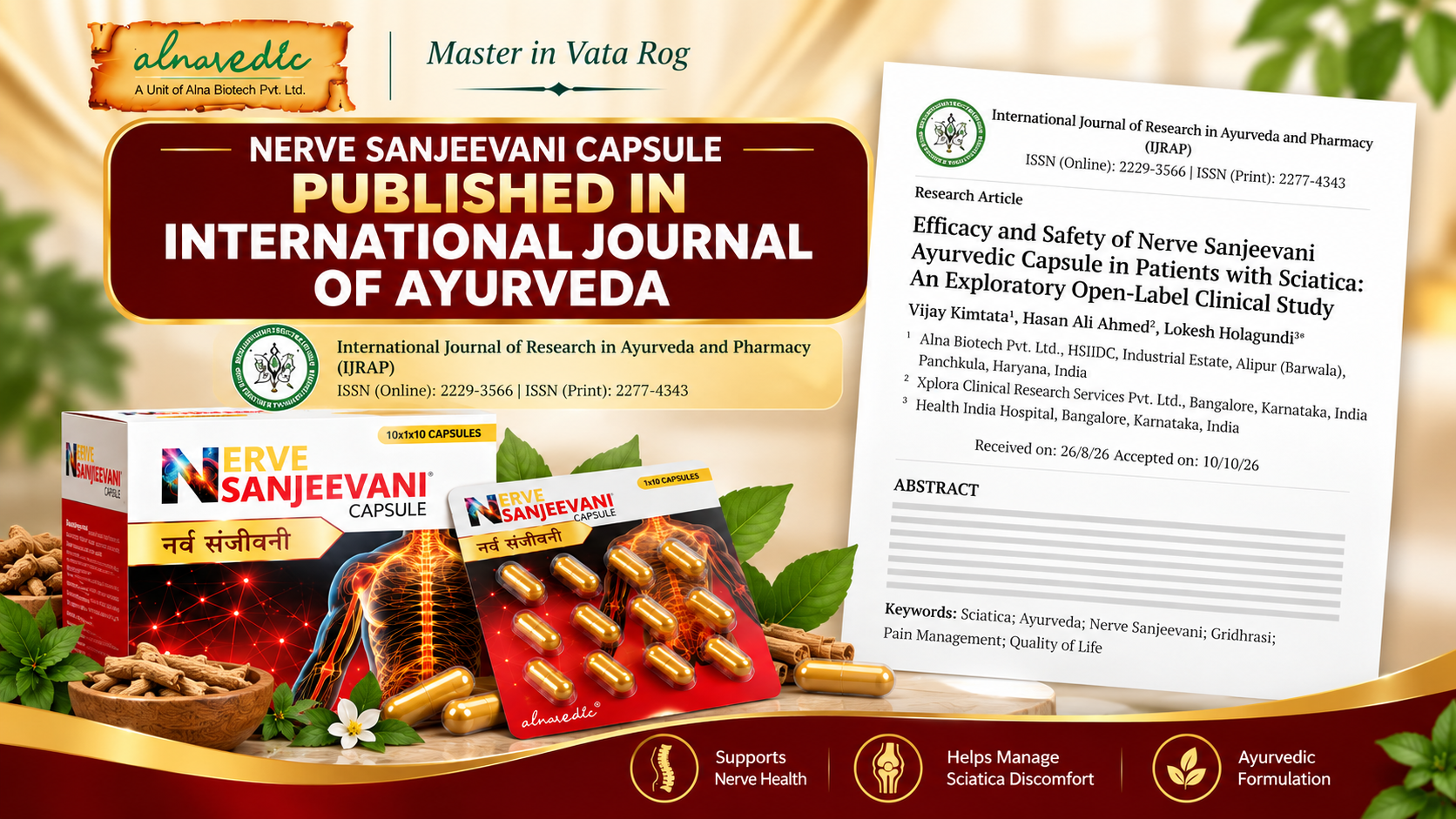
Nerve Sanjeevani Ayurvedic Capsule Published in International Journal of Research in Ayurveda and Pharmacy
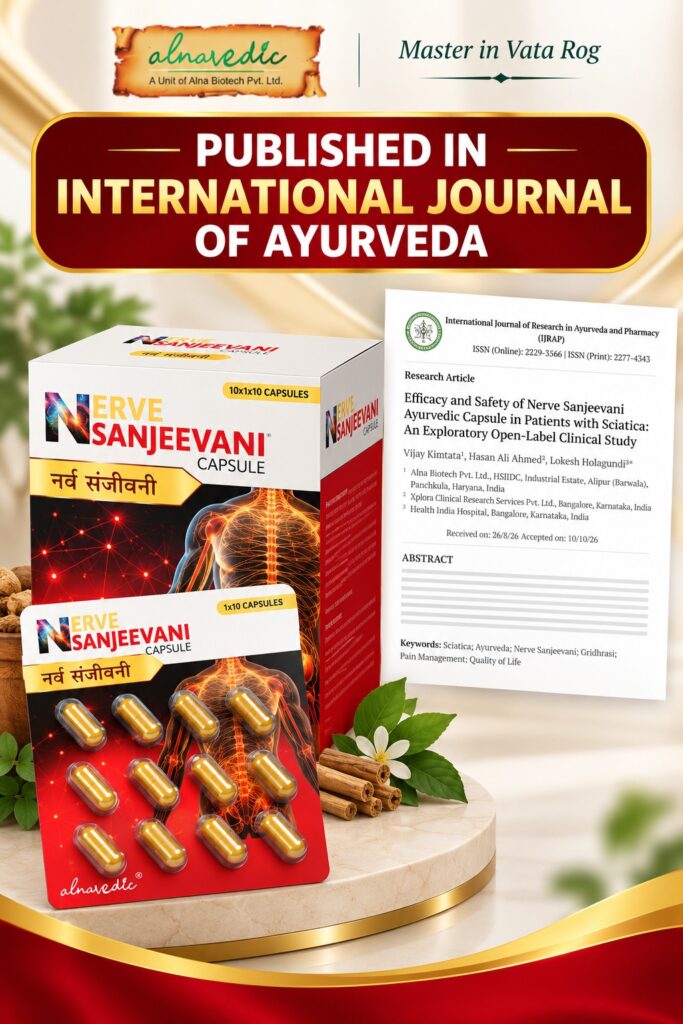
Alna Biotech Pvt. Ltd. is pleased to share the publication of a clinical research study evaluating Nerve Sanjeevani Ayurvedic Capsule in patients with sciatica in the International Journal of Research in Ayurveda and Pharmacy (IJRAP), Volume 17, Issue 5, 2026.
The research, titled “Efficacy and Safety of Nerve Sanjeevani Ayurvedic Capsule in Patients with Sciatica: An Exploratory Open-Label Clinical Study,” explores changes in pain intensity, physical disability, sciatica-related symptoms and health-related quality of life during a 14-day study period.
Understanding Sciatica and Gridhrasi
Sciatica is a condition associated with pain that radiates from the lower back or buttock down the leg. Some people may also experience numbness, tingling, weakness or difficulty performing everyday activities.
In Ayurveda, sciatica-like symptoms are commonly correlated with Gridhrasi, a condition traditionally associated with Vata dosha. The study explored Nerve Sanjeevani Ayurvedic Capsule in this clinical context.
About the Clinical Study
The exploratory study enrolled 52 adults with sciatica, of whom 50 completed the study and were included in the final efficacy analysis.
Participants received Nerve Sanjeevani Ayurvedic Capsule, 650 mg, orally twice daily for 14 days. Researchers assessed outcomes at the beginning and end of the study using established assessment tools.
The assessments included:
-
Pain intensity: Numeric Rating Scale (NRS)
-
Physical disability: Roland-Morris Disability Questionnaire for Sciatica (RMDQ-S)
-
Sciatica-related symptoms: Sciatica Bothersomeness Index (SBI)
-
Overall perceived change: Global Perceived Change (GPC) scale
-
Health-related quality of life: Short Form-36 (SF-36)
Safety assessments included vital signs, laboratory investigations and monitoring for adverse events.
Key Findings Reported in the Study
The researchers reported statistically significant reductions in pain intensity, physical disability and sciatica-related symptom burden after 14 days.
The study reported the following changes in mean scores:
-
Pain intensity (NRS): Decreased from 6.48 to 2.00.
-
Physical disability (RMDQ-S): Decreased from 17.28 to 10.62.
-
Sciatica-related symptom burden (SBI): Decreased from 13.50 to 8.52.
The reported changes in these measures were statistically significant, with p-values below 0.0001.
The study also reported improvements in selected health-related quality-of-life measures, including physical functioning and vitality.
These results represent the outcomes observed among study participants during the study period. Because the research was exploratory and did not include a control group, the findings do not establish that the changes were caused solely by the study product.
Safety Observations
During the 14-day study, six mild adverse events were reported: headache, cold and cough, body pain, stomach pain and fever. The researchers considered these events unlikely to be related to the study intervention. No serious adverse events were reported.
The study’s short duration means that its findings cannot establish the product’s long-term safety. Further research is needed.
Research Publication Details
Journal: International Journal of Research in Ayurveda and Pharmacy (IJRAP)
Article title: Efficacy and Safety of Nerve Sanjeevani Ayurvedic Capsule in Patients with Sciatica: An Exploratory Open-Label Clinical Study
Authors: Vijay Kimtata, Hasan Ali Ahmed and Lokesh Holagundi
Publication: Volume 17, Issue 5, 2026
Study registration: CTRI/2025/08/093697
Continuing the Journey of Research and Evaluation
The publication represents a research milestone for Alna Biotech Pvt. Ltd. by documenting a clinical evaluation of Nerve Sanjeevani Ayurvedic Capsule in adults with sciatica.
The authors note that larger randomized controlled studies with longer treatment and follow-up periods are needed to confirm these preliminary findings and further evaluate safety.
Disclaimer: This article summarizes findings from an exploratory clinical study and is intended for informational purposes only. The study’s results should not be interpreted as definitive proof of treatment effectiveness or long-term safety. Consult a qualified healthcare professional for diagnosis and treatment advice. Do not start or change treatment based solely on this article.